 Better Photos Guide
 If you’re searching for a tripod for macro photography, the listicles ranking on Google’s first page will tell you to look for “stability, height adjustability, and load capacity.” Those are the wrong criteria.
After scanning roughly 350 user comments across r/macrophotography, r/photography, and r/AskPhotography threads about choosing a tripod for macro photography, the same complaints surface over and over — and none of them are about stability in the way generic tripod guides frame it. The real problems are diffraction past f/8, a depth of field measured in fractions of a millimeter at 1:1 magnification, shutter-induced vibration that ruins shots even on a “stable” setup, and a focus-stacking workflow that 100% of the listicle articles skip entirely.
This guide reorganizes the tripod question around what those photographers actually run into. The center column matters more than load capacity. Which lens you choose before the tripod can save you from buying the wrong tripod entirely. And one decision — Photoshop versus dedicated stacking software — quietly determines whether your tripod investment pays off at all.
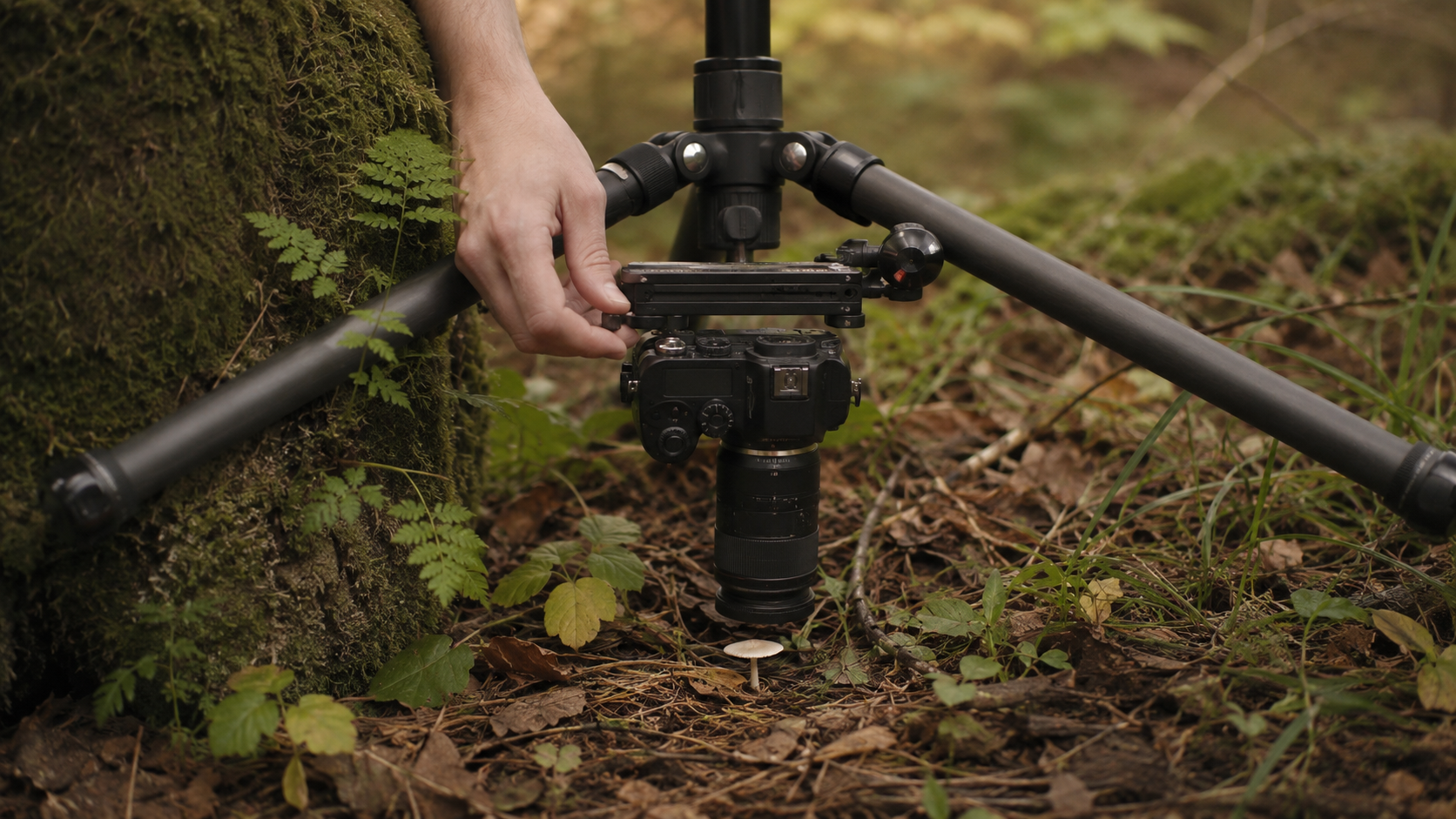
The Real Reason You Need a Tripod for Macro (It’s Not What the Listicles Say)
Generic tripod articles default to “you need a tripod because macro requires slow shutter speeds.” That’s only half the story. The deeper reason most experienced macro shooters use a tripod is focus stacking — and once you understand the physics, the criteria for choosing a tripod change.
Here’s the constraint nobody mentions in the top SERP results: at 1:1 magnification, depth of field collapses to about 1 mm at f/16, regardless of which lens or camera you use. One photographer in r/photography with 325 upvotes put it bluntly: “It’s physics. You can raise your aperture all you want (within reason) but it’s still probably not going to get the whole thing in focus.” A separate reply added: “at superclose macro, F16 can be less than 1mm DoF.”
So you can’t just stop down further to fix it. And even if you tried, you’d hit a second wall — diffraction. Across 89 separate Reddit comments analyzing macro aperture choice, the consensus is that diffraction starts visibly softening images well before f/16. On many macro lenses, peak sharpness sits between f/4 and f/8. As one user noted: “Your images will be diffraction limited well before f/8.”
The implication: if you want a fully sharp 3D macro subject, you need to take multiple frames at the lens’s sharpest aperture (often f/4–f/8) and stack them. And to stack reliably, the camera cannot move between frames. That’s the actual job your tripod is doing — not “preventing camera shake,” but holding position to within a fraction of a millimeter across 30 to 100 sequential exposures.
This changes everything about which tripod you should buy.
50mm vs 90mm vs 105mm — Choose the Lens Before the Tripod
This section feels off-topic for a “tripod” article. It isn’t. A surprising amount of tripod regret traces back to picking the wrong macro lens first.
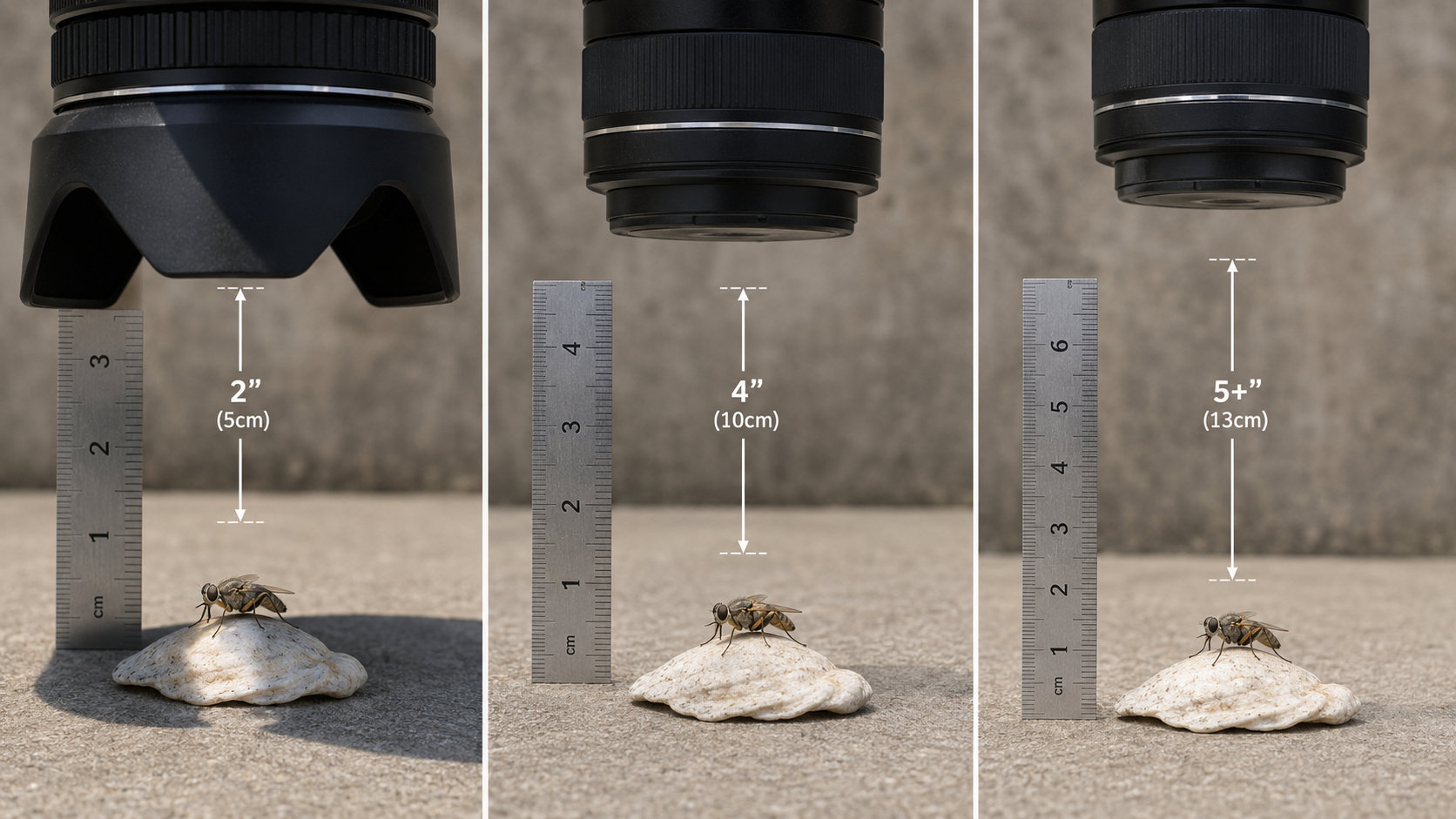
Here are the numbers that don’t show up in most lens-vs-lens listicles. On the Nikon Z system, the 50mm macro has a minimum focus distance of 2.26 inches at 1:1 magnification. The 105mm macro: 5.28 inches. More than double. Sigma’s 105mm f/2.8 Macro and Sony’s 90mm f/2.8 Macro G OSS sit in similar ranges.
Why this matters for your tripod: a 50mm macro forces you and your tripod within roughly 2 inches of the subject at full magnification. In practice, that means:
- Your lens hood, ring flash, or front element casts a shadow on the subject (the same focal-length tradeoff that drives wildlife photography lens choice, but with consequences reversed at close range)
- Live insects fly off before you can frame the shot
- You can’t fit the tripod legs in close enough without bumping the subject or the surface
- Even a tripod with reversible center column hits geometric limits
One r/AskPhotography commenter framed the regret directly: “The 105 went on eBay with no regrets other than that I took advice to buy that over the 50mm.” Another reply pushed back, arguing the 50mm has its place — but only for users not shooting at 1:1 or 2:1. Subjects 1–2 inches from the lens are the hard mode where the 50mm starts to break down.
Across 35 Reddit comments comparing 50mm to 100/105mm macro lenses, the working-distance issue dominates. If you anticipate any live-subject macro at 1:1, plan around the 90/100/105mm class first — then choose a tripod that supports the working geometry that lens enables. If you commit to a 50mm and a tripod with no center-column reversal, you’ve built a setup that can’t reach its own subject.
Tripod Features That Actually Matter for Macro (and Three That Don’t)
Most “best tripods for macro photography” listicles emphasize load capacity, leg sections, carbon fiber construction, and maximum height. For macro work, those are mostly noise. The features that matter come from the geometry of how you’ll actually shoot.
What matters
1. Center column that reverses or removes. A reasonable share of macro shots happen at ground level — flowers, fungi, small invertebrates on the forest floor. A fixed center column physically prevents getting the camera low enough. Tripods like the Manfrotto 055 series support a 90° column rotation; budget tripods often don’t. Confirm this before buying.
2. Independent leg angles. Macro setups often need one leg extended over uneven terrain (a log, a rock, a different soil level) while two legs stay close to the subject. Cheap tripods lock all three legs at the same angle, which forces you to recompose around the tripod rather than the subject.
3. A head that allows micro-adjustment. A standard ball head will get you close, but holding sub-millimeter framing while you tighten the clamp is fiddly. Geared heads (Manfrotto 410, Arca-Swiss Cube, smaller Acratech) give you incremental control on each axis. For focus stacking specifically, this matters more than head load capacity.
4. A flat surface or removable center column for direct macro-rail mounting. If you’re going to focus-stack — and most macro shooters eventually will — you’ll mount a focusing rail between the tripod and the camera. The cleaner the interface (Arca-Swiss clamp, no center column in the way), the less drift over a 50-frame stack.
What doesn’t matter
“Up to 200 kg / 440 lb load capacity.” A macro setup is camera + macro lens + maybe a rail. You’re never near a load limit that matters. Marketing-heavy tripod specs around load are designed for video and long telephoto, not macro.
Carbon fiber. Carbon fiber’s selling point is weight savings during long hikes. Macro photography happens in 30 cm of the ground, often within 100 m of your car. Aluminum is fine and saves $200–$400.
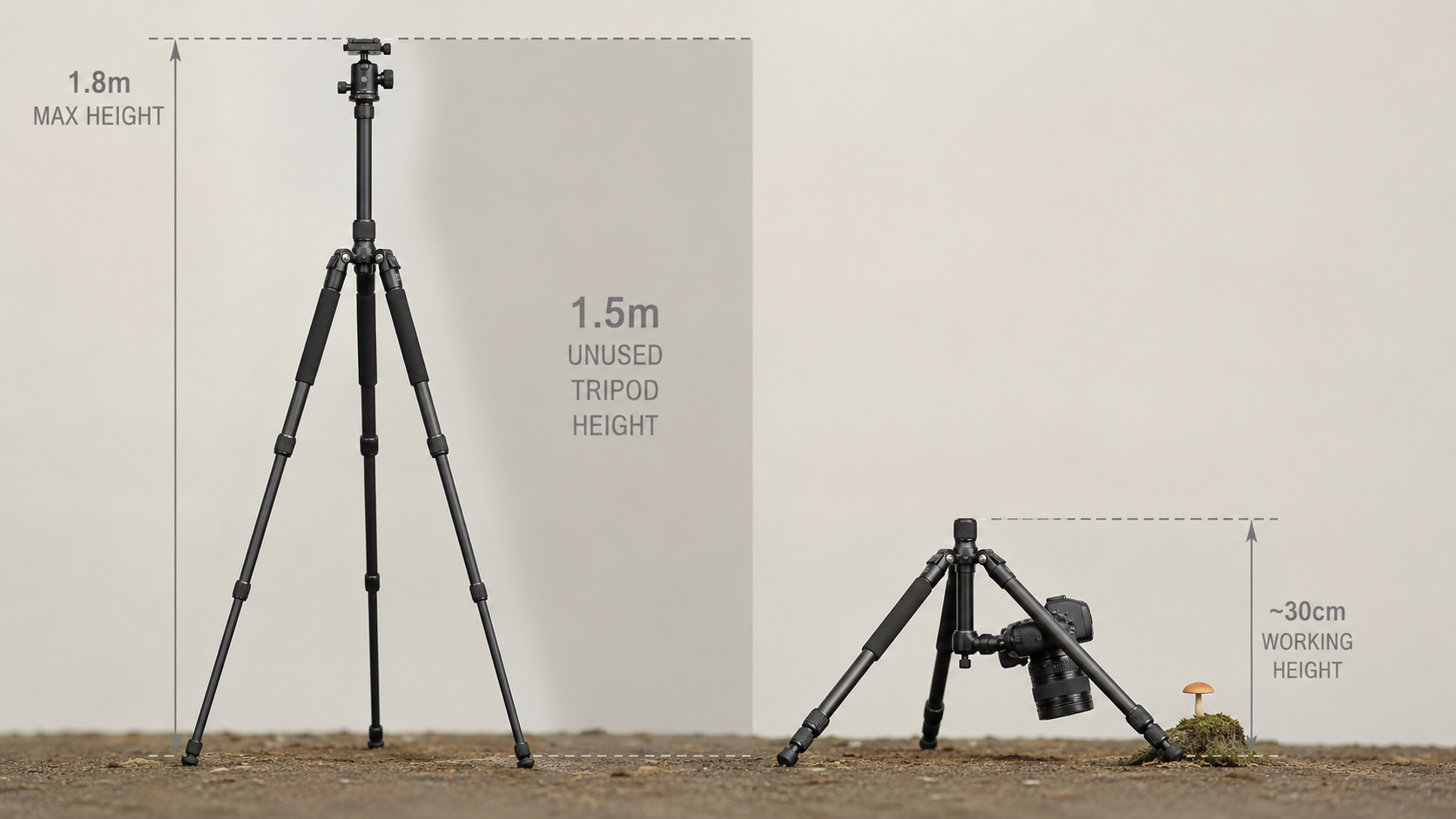
Maximum height of 1.8 m. You will use about 30 cm of that height. The rest is irrelevant. A shorter, sturdier tripod with a removable center column beats a tall flimsy one for macro every time.
This isn’t a “buy this one specific tripod” article. The point is: when you’re scanning the spec sheet, ignore the marketing headline features and check the four geometric features above.
The Shutter Problem the SERP Doesn’t Mention
You can have a perfect tripod, the right lens, the right aperture, and still get a soft macro shot. The reason isn’t your tripod — it’s the act of pressing the shutter button.
Across 29 Reddit threads discussing camera shake on macro setups, this pattern repeats: photographers think their tripod is the problem, but the actual vibration source is their finger touching the camera. At 1:1 magnification, even sub-millimeter movement is magnified into visible blur. The mitigations recommended consistently:
- Remote shutter release or wireless trigger. Cheap on Amazon ($10–30), removes finger-contact vibration entirely.
- 2-second self-timer at minimum, 5–10 second timer when stacking. Lets the tripod fully damp after you touch the camera.
- Electronic first-curtain shutter (EFCS) on mirrorless, or mirror lock-up on DSLR. Removes mirror-slap shock — a real issue on bodies like the older Nikon D850 at high magnification.
The shutter speeds actually used by Reddit users posting macro stacks back this up. One commenter shared full settings: “Vivitar 100mm Macro lens, ISO: 100, Shutter: 1/2 second (probably much slower than I’ll use next time).” Another: “16 exposures at f/6.7 and 3 second shutter speed.” A third referenced a single exposure at f/9.5 and 6 second shutter.
These are not “use 1/200 to freeze motion” shutter speeds. Macro stacks routinely sit between 1/4 second and 6 seconds per frame, with ISO 100 to keep noise out of fine detail. That means the tripod has to hold position through a long, repeated exposure cycle — and every shutter press is a chance to inject vibration. Remote trigger is not optional gear; it’s table stakes.
Focus Stacking Workflow (Where 100% of the SERP Goes Silent)
This is the section the top-ranking listicles entirely skip. They’ll mention “focus stacking” once as a feature bullet, then move on. But focus stacking is where your tripod choice either pays off or becomes a $200 mistake.
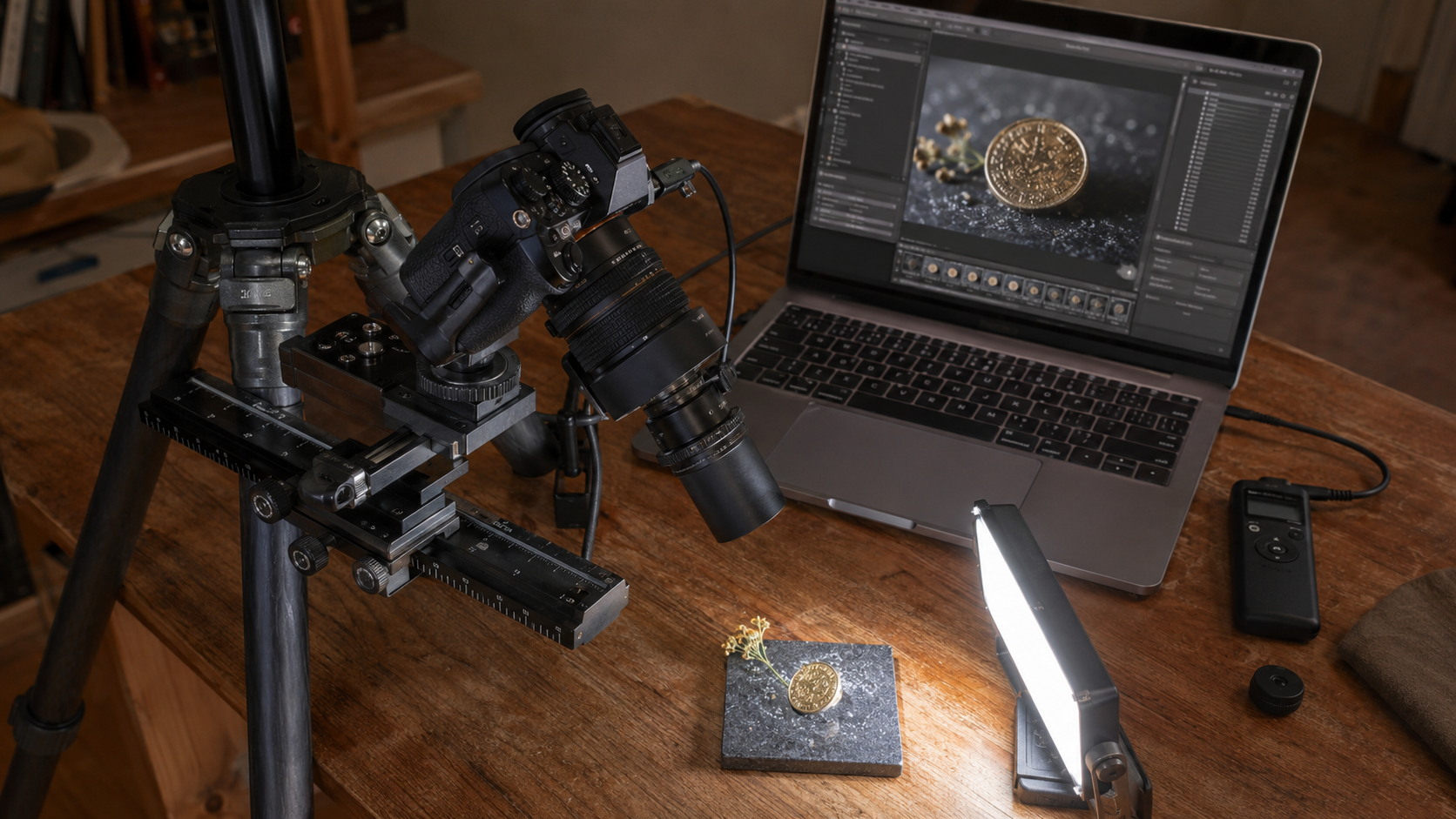
The macro rail (you probably need one)
A macro focusing rail sits between your tripod plate and the camera, letting you advance the camera forward by a known, controllable distance — typically 0.5 mm to 5 mm per frame at high magnification. Without a rail, you have to rotate the lens’s focus ring between shots, which shifts magnification slightly and makes the stack harder to align.
Across 11 Reddit threads on macro rails specifically, the recurring point is that a basic rail ($40–80, often labeled “2-axis macro rail” on Amazon) is enough to start. The high-end options — Really Right Stuff makes a rail that costs roughly 3× the budget options, and users acknowledge it’s noticeably better — but the entry-level rail is the difference between “can focus stack reliably” and “can’t.” One user described upgrading from no rail to a basic 2-axis: “Mine taken after using a macro rail. Working with living things, you need to be extra fast before they move.”
The software choice (this one is loud)
Across 20 separate Reddit comments mentioning focus-stacking software, the pattern is unambiguous: do not use Photoshop for serious macro stacks. Quotes from r/AskPhotography:
“Photoshop sucks at focus stacking, you need to correct the errors manually.”
“I’m a macrophotographer, stacking is my bread and butter. I’ve used many pieces of software to do it and Photoshop is the worst by a landslide. Basically unusable.”
“Photoshop is not the best at focus stacking and more complex subjects are harder to stack especially with overlapping features.”
The two consistent recommendations:
- Helicon Focus. $115 license, 30-day free trial. Multiple users report it “almost always” produces cleaner composites than Photoshop, particularly when there’s any camera shake between frames.
- Zerene Stacker. Around $89 for the personal edition. A common workflow suggestion: “For advanced use, make two stacks, one pmax, one dmap, and clean up by hand” — combining the strengths of each algorithm.
Why does this matter for tripod choice? If you commit to Helicon or Zerene, the software is robust enough to handle minor stack drift, which means a mid-range tripod ($150–400) is enough. If you insist on Photoshop, you’ll need a much steadier setup and possibly a heavier rail to compensate for the software’s limitations. The software you choose changes the tripod budget you actually need.
Frame count expectations
Stacks on Reddit range from a single subject built from 16 exposures on the low end to 112 stacked frames on the high end (a spider portrait posted in r/macrophotography). Common counts: 30 to 80 frames. At 2–5 seconds per frame including remote trigger delay, that’s 2–10 minutes per stack. Your tripod and rail need to hold position the entire time.
When You Don’t Actually Need a Tripod
A counter-position worth mentioning. Three separate r/macrophotography users argued that with modern in-body image stabilization, you can shoot 1:1 macro handheld. The most-cited examples were Sony A7R V + 90mm f/2.8 Macro G OSS, and Panasonic G9 II + Olympus macro glass on Micro Four Thirds.
The tradeoffs:
- Handheld works only up to roughly 1:1 magnification. Beyond that (2:1, 5:1 with lenses like the Laowa 25mm f/2.8 2.5–5x), the DoF window is too thin to hold steady.
- Handheld removes the option to focus-stack reliably. You can do “lucky stacks” with continuous burst + IBIS, but precision focus stacking still requires a stable rail.
- Handheld lets you follow moving subjects (live insects) that flee before a tripod is set up.
If your macro interests are mostly active subjects — bees on flowers, spiders moving across grass — IBIS handheld can be the better choice. If your interests are static or controlled subjects (mushrooms, lab specimens, jewelry, dead insects in a studio) or you want maximum sharpness through stacking, a tripod is non-optional.
Tripod Marketing Features You Should Ignore for Macro
Quick reference, organized by what’s emphasized in the average “best tripod for macro photography 2026” listicle vs. what actually matters at the tripod height where macro happens.
| Feature pushed in listicles | Why it doesn’t matter for macro |
|---|---|
| 200 kg load capacity | Macro setup weighs 1.5–3 kg. Any tripod handles it. |
| Carbon fiber construction | You’re 30 cm from the ground, not hiking. Aluminum is fine. |
| Maximum 1.8 m height | You’ll use roughly 30 cm of that. Shorter, sturdier wins. |
| 5-section legs for compactness | More leg sections = more flex points. Fewer is better for stacking. |
| “Built-in monopod conversion” | Macro is not a monopod use case. |
| Air-cushioned center column | You’ll remove or reverse the column anyway. |
Look instead for: center column reversal/removal, independent leg-angle locks, geared-head compatibility (Arca-Swiss clamp), and as few leg sections as the height allows.
Frequently Asked Questions About Tripods for Macro Photography
Can I use any tripod for macro photography?
Technically yes, but the critical feature is whether the tripod’s center column can be reversed, removed, or rotated to a horizontal position. Without that, you cannot get the camera to ground-level macro subjects. A 200 kg load-rated travel tripod with a fixed center column is worse for macro than a $120 tripod with a removable column.
Do I need an expensive macro rail?
No. Across Reddit discussions, basic 2-axis rails in the $40–80 range are described as “sufficient to start.” The premium options (Really Right Stuff’s rail at roughly 3× the budget price) are noticeably better, but the limiting factor for most beginners is the focus-stacking software, not the rail’s mechanical precision.
Manfrotto 055 vs. Really Right Stuff for macro — is the price difference worth it?
The 055 series handles 95% of macro use cases well — center column reverses, legs splay independently, the platform accepts an Arca-Swiss head. RRS becomes worth it if you focus-stack 50+ frame sequences regularly and need rock-solid drift performance over multi-minute stacks. For most photographers, the Manfrotto is the right choice and the savings fund a better head or rail.
Should I use Photoshop or Helicon Focus for stacking?
Across 20 Reddit comments comparing the two, Photoshop’s stack mode is consistently described as inadequate for serious macro work — ghosting on overlapping edges, misalignment with focus-ring stacks, struggling with complex 3D subjects. Helicon Focus ($115, 30-day free trial) and Zerene Stacker ($89) are the routinely cited replacements. Pmax + dmap two-pass workflow in Zerene is a recurring expert recommendation.
What shutter speed should I use for macro on a tripod?
Reddit examples range from 1/2 second to 6 seconds per frame at ISO 100, depending on lighting and aperture. The point of a tripod is to enable those slow speeds without blur. Always use a remote trigger or 2–5 second self-timer to remove finger-press vibration.
Is f/16 enough depth of field for macro?
Not at 1:1 magnification. Even at f/16 you’re working with around 1 mm of depth of field at full macro magnification. Beyond that, diffraction degrades sharpness. The practical solution isn’t a smaller aperture — it’s focus stacking at the lens’s sharpest aperture (often f/4–f/8).
Bottom Line
A tripod for macro photography is not chosen on the same criteria as a tripod for landscape or wildlife. The job is fundamentally different: holding sub-millimeter position across 30–100 sequential exposures at slow shutter speeds, while reaching ground-level subjects through a reversible center column. Load capacity, carbon fiber, and maximum height — the headline specs of generic tripod listicles — are largely irrelevant in this use case.
Three decisions made in the right order eliminate most of the regret patterns visible in macro photography forums:
- Choose the lens first. 90/100/105mm class for any live-subject work at 1:1. The 50mm macro is a working-distance trap.
- Buy a tripod for geometry, not specs. Center column that reverses or removes; independent leg-angle locks; Arca-Swiss head plate; minimum leg sections that get you to the height you actually use (about 30 cm).
- Plan for focus stacking from day one. Budget $40–80 for a basic 2-axis macro rail and $89–115 for Helicon Focus or Zerene Stacker. Photoshop’s stack mode is not a substitute, per repeated user reports.
The “best tripod for macro photography” articles ranking on Google rarely walk through these decisions because their primary structure is product recommendations, not problem framing. The good news for anyone starting out: the tripod for macro doesn’t need to be expensive, but it does need to be the right shape. Most $150–400 tripods with the geometric features above will work for years.
For broader equipment decision frameworks across photography categories — including telephoto, real estate, and travel setups — see the rest of the Gear Guide.